
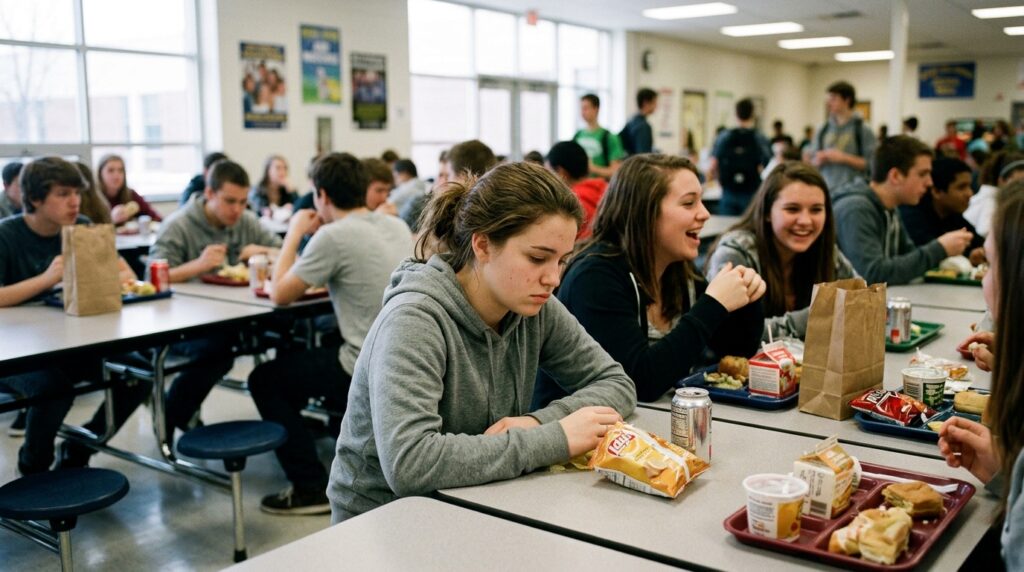
For many teenagers, navigating peer drama and social friction can feel overwhelming. Now, new psychological research highlights how deeply interpersonal friction can influence daily dietary choices. According to a study published in Applied Psychology: Health and Well-Being, social distress drives adolescents toward junk food far more aggressively than non-social stress, but learning how to mentally reframe those negative encounters can help curb the urge to snack.
Social Heartache and the Urge to Snack
Adolescent obesity remains a pressing global public health challenge, frequently exacerbated by emotional eating and the excessive consumption of calorie-dense comfort foods. While psychologists have long recognized that stress prompts poor dietary decisions, researchers led by Haide Chen investigated whether the origin of that stress matters.
Drawing on models of how the brain processes emotional stimuli and the incentive sensitization theory, the authors examined how negative affect specifically triggered by social scenarios alters adolescent appetite. Their findings indicate that interpersonal pain wields a uniquely powerful influence over dietary cravings compared to other everyday frustrations.
Comparing Stressors: Why Social Pain Matters Most
To test this dynamic, the researchers conducted an initial experiment involving junior high school students. The participants were exposed to three distinct experimental conditions designed to elicit different emotional states: socially induced negative emotions, non-social negative emotions, and emotionally neutral scenarios.
Following these emotional inductions, the researchers tracked the students’ food selection. The results showed that participants subjected to socially induced distress consumed significantly higher amounts of high-calorie food than those in both the non-social distress and neutral control groups. This suggests that peer-related emotional turmoil possesses a particularly potent ability to stimulate cravings, showing that not all adolescent stress impacts the appetite equally.
Reframing vs. Bottling Up: The Deciding Factor
Recognizing that social stress poses a distinct risk for overeating, the researchers conducted a second experiment to test whether specific coping mechanisms could shield adolescents from temptation. They compared two widespread emotion regulation strategies: cognitive reappraisal, which involves reframing an upsetting situation in a more constructive light, and expressive suppression, in which an individual attempts to hide or bottle up their feelings.
The differences were striking. When adolescents facing social distress engaged in cognitive reappraisal, they chose significantly less high-calorie food than peers who relied on expressive suppression. Simply bottling up social anxiety or sadness did little to dampen the urge to snack, whereas actively reframing the interpersonal problem proved effective at reining in comfort-seeking consumption.
Targeted Interventions for Healthier Habits
The study’s conclusions suggest that conventional anti-obesity and wellness campaigns may be missing a vital component by focusing almost exclusively on nutritional education and calorie counting. When teenagers experience social exclusion, peer conflict, or embarrassment, standard dietary advice often falls by the wayside.
Instead, the authors argue that adolescent health programs should incorporate targeted emotional literacy. Teaching young people how to practice cognitive reappraisal when dealing with complex social dynamics could serve as a valuable psychological buffer, transforming how teenagers manage stress and safeguarding them against emotion-driven overeating.
Source
- Does socially induced negative affect influence high‐calorie food intake in adolescents? The role of emotion regulation strategy
- Researchers: Haide Chen, Jianxiong Zhang, Yixing YANG, Yang Zheng, Xiaowei Chu
- Journal: Applied Psychology Health and Well-Being
- Read the original study