
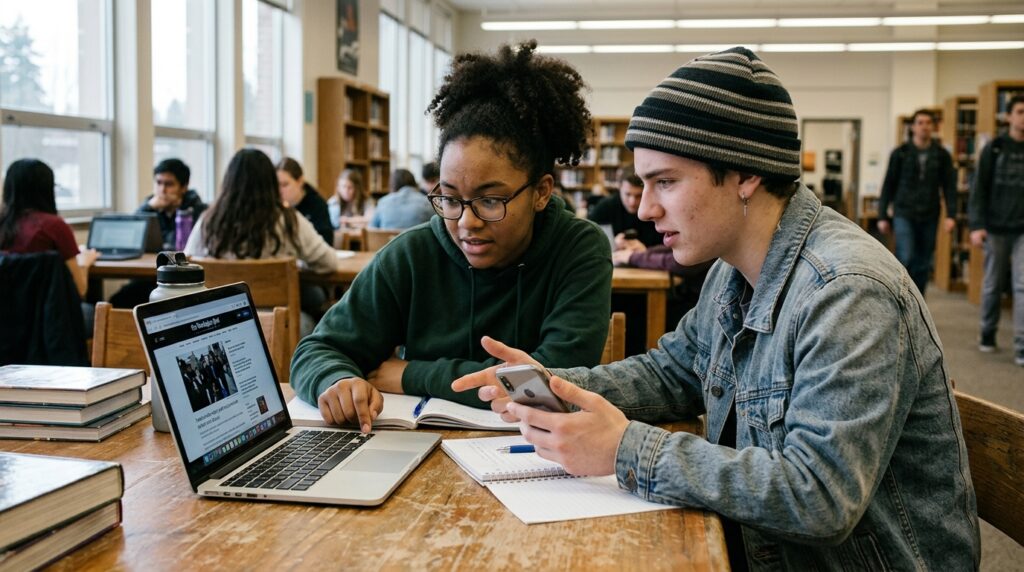
In an era dominated by fast-moving social feeds, why do some teenagers pause to verify a dubious headline while others share it without a second thought? A new study published in the Journal of Media Psychology reveals that the answer may lie in an unexpected psychological virtue: intellectual humility. Researchers found that adolescents who readily accept that their own beliefs could be mistaken are far more inclined to double-check suspicious claims online, largely because they refuse to use mental excuses that justify negligent online behavior.
The Challenge of Misinformation for Young Minds
Adolescents navigate an endless deluge of digital content every day, regularly encountering sensational headlines, altered media, and misleading claims across social platforms. Because young people rely heavily on these networks for social connection and current events, learning how to confront misinformation has become an urgent developmental necessity. Yet, while most young people have access to online search tools, their willingness to actually use them varies dramatically. Intrigued by this gap, a team of Italian researchers set out to uncover the underlying psychological processes that motivate certain teenagers to actively investigate doubtful posts while others let questionable information pass without scrutiny.
Recognizing Fallibility Stops Moral Excuses
The researchers focused on intellectual humility—the cognitive capacity to recognize that one’s own viewpoints and knowledge may be flawed or incomplete. While past studies established a link between this trait and a greater willingness to scrutinize suspicious content, the psychological route connecting the two remained unexplored.
The authors found the key in moral disengagement, a set of self-serving cognitive justifications people use to excuse unethical behavior while preserving a positive self-image. In digital environments, moral disengagement often manifests as rationalizations like “everyone shares rumors” or “it is not my responsibility if the story turns out to be false.” According to the study, teenagers with higher intellectual humility were significantly less inclined to rely on these defensive excuses. By resisting self-serving justifications, they remained far more committed to fact-checking questionable information. Statistical analyses revealed that moral disengagement fully mediated the relationship between intellectual humility and information verification intentions.
Testing Teens Through an Interactive App
To evaluate these dynamics, the research team studied 380 Italian adolescents with an average age of 14.43 years. Rather than relying solely on abstract paper-and-pencil surveys, the researchers engaged participants through a conversational web application designed to assess their psychological attitudes in a naturalistic digital context. By simulating a familiar, chat-style interface, the tool evaluated the adolescents’ levels of intellectual humility, their tendency to deploy moral disengagement strategies, and their genuine intentions to verify unconfirmed content before passing it along.
A New Blueprint for Digital Literacy
These findings suggest that traditional media literacy initiatives may need to evolve. Teaching technical skills alone—such as checking author credentials or conducting reverse image searches—may fall short if students routinely rationalize the act of sharing unverified content. The study highlights the need for educational programs that actively cultivate metacognition, guiding young minds to self-reflect, embrace humility regarding their own perspectives, and take personal ethical responsibility for the information they circulate online.
Source
- Is Information Verification Just a Matter of Intellectual Humility?
- Researchers: Carmela Sportelli, Paolo Giovanni Cicirelli, Giuseppe Corbelli, Marinella Paciello, Francesca D’Errico
- Journal: Journal of Media Psychology Theories Methods and Applications
- Read the original study