
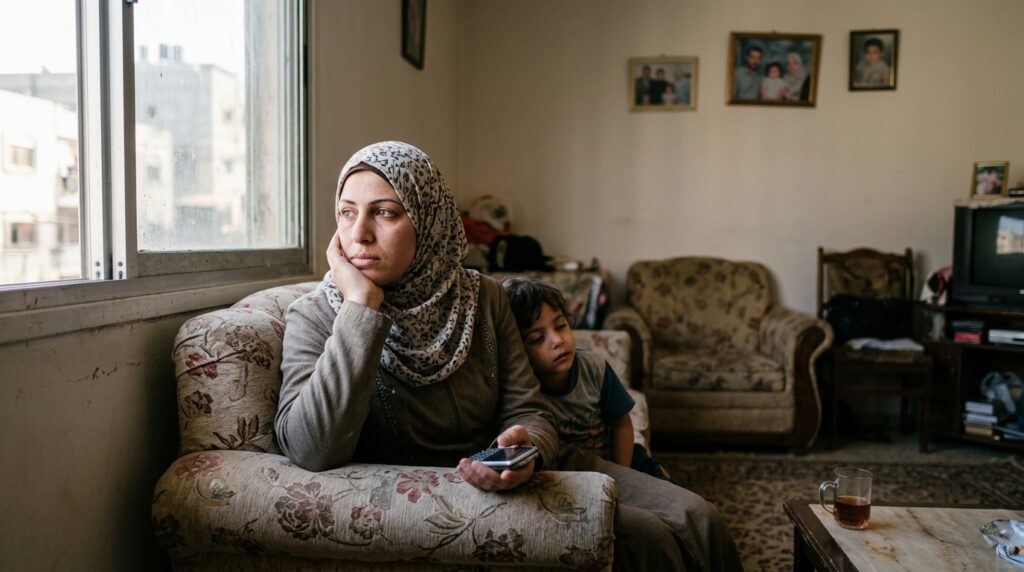
For civilians caught in the crosshairs of prolonged warfare, the horrors of conflict extend far beyond physical destruction to alter the very fabric of how time is experienced. A new qualitative study published in the journal Subjectivity reveals that continuous military violence in the Gaza Strip has fundamentally reorganized civilian consciousness, transforming temporality into an agonizing, suspended state where the future ceases to exist.
Time as Suspended Life
Researchers found that displaced civilians living under persistent violence do not experience time as a linear, forward-moving continuum. Instead, participants described their daily existence as fractured, frozen, and completely severed from future orientation. Rather than anticipating rescue, ceasefires, or post-war reconstruction, many participants reported an excruciating state of waiting for death.
According to the findings, the passage of days was no longer measured by conventional routines, milestones, or hopes. Instead, time was tracked solely through cumulative loss, personal grief, and physical destruction. Under these severe conditions, any psychological sense of a viable tomorrow collapsed into an inescapable, overwhelming present.
Delay as a Dimension of Control
The study, authored by researchers Guido Veronese, Bilal Hamamra, and Fayez Azez Mahamid, argues that prolonged waiting is far from an incidental byproduct of war. Rather, the authors contend that waiting operates as a deliberate, structured mechanism that exerts psychological control and drains civilian energy. Displaced individuals reported a profound sense of “temporal fatigue,” characterized by overwhelming helplessness stemming from unresolved delays, displacement orders, and constant existential uncertainty.
Drawing on necropolitical theory, the researchers assert that the manipulation of delay and uncertainty acts as an active modality of violence. By keeping a population suspended in protracted precarity, structural forces systematically deplete mental endurance and communal resilience.
Investigating Everyday Temporality
To capture the lived realities of civilians, the research team conducted in-depth, semi-structured interviews between September 2024 and March 2025. The study examined the experiences of 30 internally displaced Palestinians residing in displacement settings across Gaza during the ongoing military campaign that began in October 2023.
Utilizing analytical tools from critical psychology and decolonial feminist theory, the researchers examined how continuous structural violence actively reorganizes mundane, day-to-day perceptions of time. Their analysis identified six interrelated themes that illustrate how waiting becomes an omnipresent, politically mediated condition governing social and psychological life.
Rethinking Conflict and Mental Health
These findings present a critical challenge to standard therapeutic models. Conventional clinical frameworks often interpret psychological trauma as a reaction to past events or as acute distress resulting from an isolated disaster. In contrast, the Gaza study highlights the debilitating injury of an indefinitely stalled present, where people are systematically deprived of temporal agency.
The authors emphasize that humanitarian organizations and mental health practitioners must revise their analytical frameworks when assessing populations in protracted conflict zones. Supporting communities under sustained siege, the researchers argue, requires understanding that psychological recovery cannot take root without the fundamental ability to anticipate a safe and predictable future.
Source
- Time, waiting, and the politics of delay in Gaza during genocide
- Researchers: Guido Veronese, Bilal Hamamra, Fayez Azez Mahamid
- Journal: Subjectivity
- Read the original study